The Birds, the Bees…
The Cells, the Genes and the Proteins!
We now know a little about the build-up of your DNA, and that a mutation or error in your genetic information may have serious consequences for your development. So what actually happened, if there is a genetic cause to a disorder? What took place in your genes that manifests itself as such?
In this post we’ll dive a little bit deeper into genetics. It may be a lot of information, but I’ve tried to keep it as colourful as I could, and of course there will be Otter Words..!
Cell division
As mentioned earlier, your body is made up of millions of tiny cells. In the lifetime of one cell it passes through several stages. Your cells are continuously cloning themselves in order to make you grow and regenerate! In the interphase (the sort of in between phase) the cell prepares to split it self, and so has to duplicate genetic information stored in its nucleus. This is called DNA replication:
The DNA needs to be unwrapped, so the chromosomes are not all in x-shapes, but instead, there’s a big bundle of DNA helix in the cell core. The beautiful Helix has to split up, as if opening a zipper, to expose all the nucleotides.
This is all done by the wonderful machinery of the replisome: a complex molecular machine that is able to split the DNA helix into separate strands, and creates new DNA molecules to replicate the strand. The exposed nucleotides on each strand can be read, and the matching nucleotide is placed on top of it.
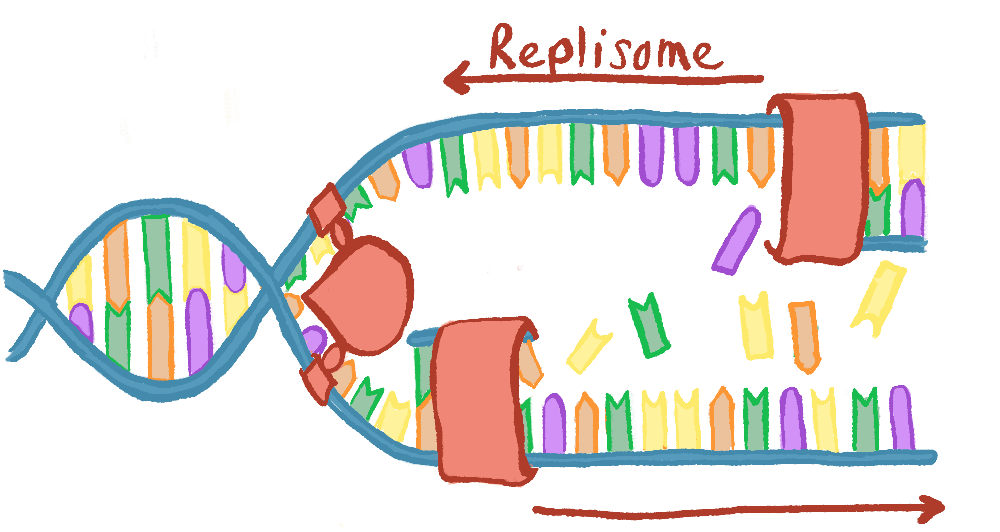
It goes through your entire genome in the nucleus of the cell, until your entire DNA is replicated!
The replisome has great power, but with great power, comes great responsibility… Some nucleotides may not be replicated at all, or wrongly This may not be a problem; it might happen in only one cell of your body, or it may be solved by the cells ‘ preventative and problem-solving methods. However, as you can imagine, one error during the replication of the genetic material may cause the creation of a lot of faulty cells as it goes on to clone itself.
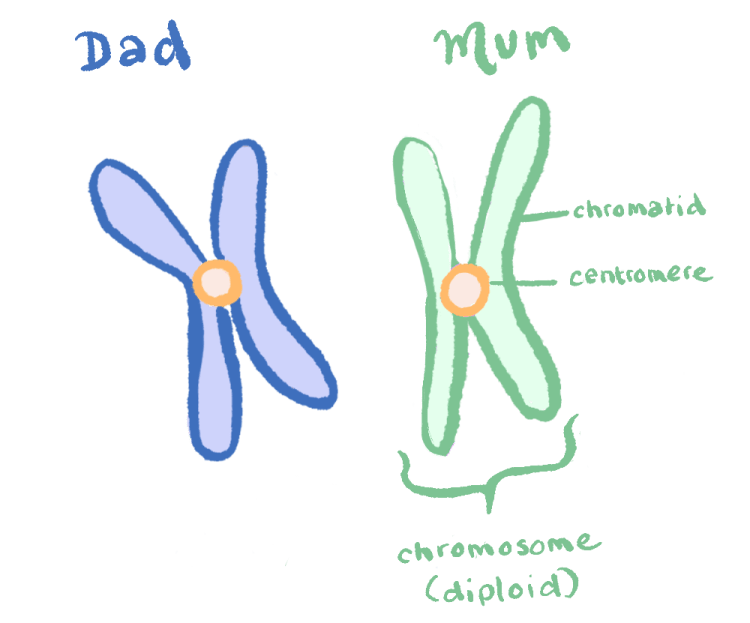
When the DNA of the whole cell is replicated, actual cell division can take place! This is called meiosis. there are a few more stages. In a few stages, your 46 chromosomes are split up and divided equally to the opposite side of each cell. You can see 2 sets here, but actually there are 23 from mum, and 23 from dad). It’s an interesting process as you can see below.
Each chromosome is split at the centromere, and its chromatids are pulled to opposite sides of the cell. When the chromosomes are equally divided, the cell splits, making two identical daughter cells.

However, the mutation that caused a developmental disability did most likely not occur during mitosis. The process we need to look at in this case is meiosis.
When you are created as a baby, you are created from two sex cells; a sperm cell from dad and an egg cell from mum. These cells are special since they have all the genetic information that all of your cells will be based on, the blueprint of your entire being! Sex cells are made during the process of meiosis, and are cloned from other sex cells. Imagine a tiny mistake made then! All of your cells cloned from this cell will be based on that initial faulty egg or sperm cell.
A cell in meiosis goes through all of the steps that a cell in mitosis, but twice!

The difference is in two parts: At the start of the process, before division, your chromosome from dad and your chromosome from dad meet each other.
These pairs can then exchange some genetic information.
Since genes for a specific role are in one specific spot on a chromosome, for instance the genes that determine your hair color, this exchange can take place easily when they are alongside each other. This is called homologous recombination.
The initial cell with double the genetic information goes through cell division twice, so that eventually four unique haploid daughter cells are created! You can see the process of meiosis in the image below, where only one set of chromosomes is displayed.
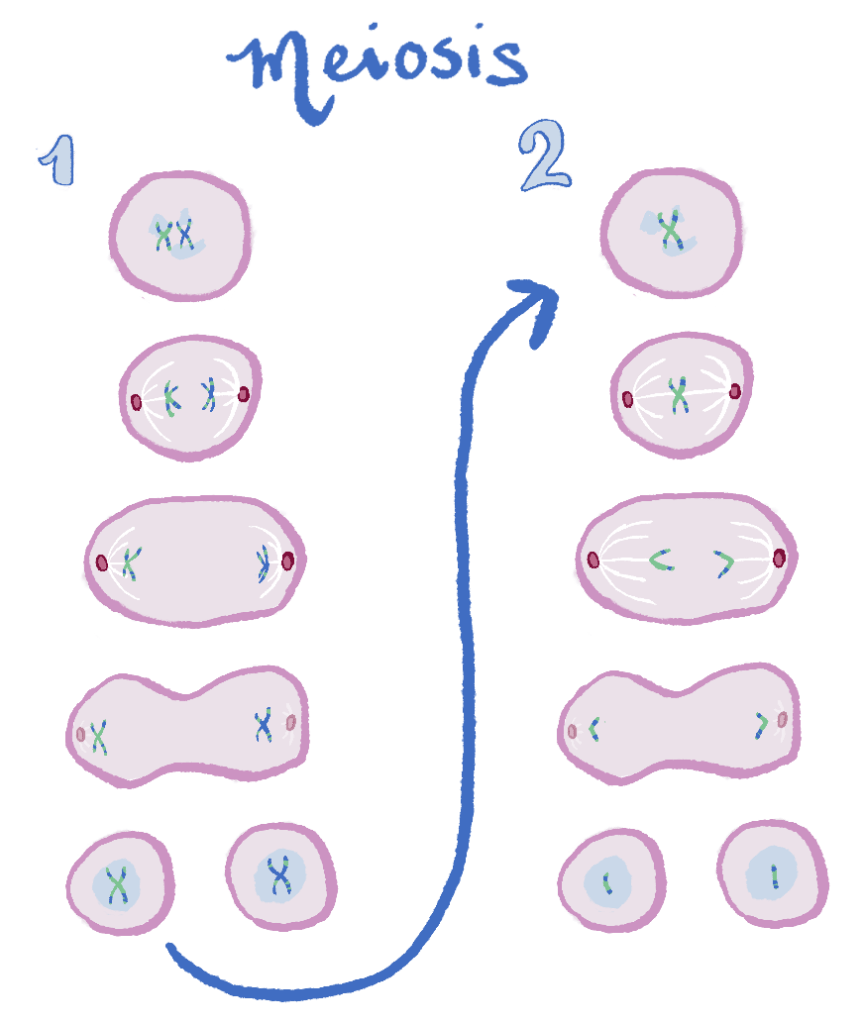
Often the severe types of intellectual find their cause during this process. As the sex cells are the foundation of an individual, a mistake made during the cloning of your genetic code will be represented in all cells of the body.
In Otter Words: Your cells continuously clone themselves in order to make your body grow and heal. Especially during your early development it is important that all these little steps are executed properly. A mistake in this can cause the mutated cell to not function properly. If a mutated cell is still able to clone itself, a large percentage of your body consists of these faulty cells. How early such a mistake takes place, can affect your development immensely.
Protein Production
When a genetic mutation causes a disorder, one part of the gene is mutated so severely that it loses it’s function: the protein that it was supposed to code for, cannot be made anymore:
Proteins are made outside of the cell core, so outside of the place where all the DNA lives. A type of messenger needs to be made from the existing DNA in order to tell the outside world what needs to be made. This messenger is RiboNucleicAcid (RNA).
When a gene is accessible, it can be copied from DNA into the RNA.
This is done by a certain enzyme called an RNA polymerase: it attaches itself to the start of the gene, and moves along it like a train across the rails while reading the letters of the gene, just like during replication. The nucleic bases are read by the enzyme, as it collects mRNA bases to make a matching strand of messenger RNA.
But when the new nucleotides are collected to make the messenger RNA, instead of Thymine, Uracil is added in.
The presence of Uracil in an RNA strand, indicates that that particular strand is a messenger.
Messenger RNA is the messenger of the manual of your body: It holds the exact instructions to what proteins should be made.

So when the messenger RNA is fully transcribed, it travels outside of the cell nucleus and floats around until a Ribosome comes by. A Ribosome is a piece of machinery that recognises sets of the nucleic bases per set of three.
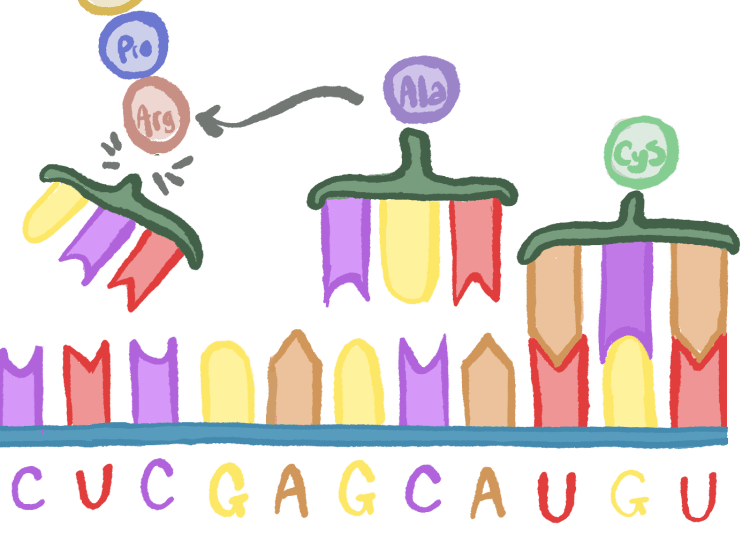
The ribosome reads the messenger RNA per three bases, and calls transfer RNA to bring the fitting amino acid. This process is called translation, as it really translates the combinations of nucleic bases into an amino acid. The amino acids are strung together to make the protein that the gene was meant to make!
While there are only four nucleic bases, in pairs of three the different combinations give the possibilities to about twenty amino acids. In one long chain of amino acid combinations, it makes up a certain protein.
And so this is how a genome instructs cells to produce the proteins we need to function! This may be a slightly simplified version, as more tiny intricate steps are necessary, but this is what it comes down to.
A genetic mutation early in your development can prevent an important protein from being made in a large part of your cells. Depending on the role of this protein, it can affect your functioning or even your chance on survival.
The gene that was mutated in my brothers’ DNA codes for a protein that is part of a very large protein-complex. This complex is responsible for determining which genes are open to be read, and transcribed into RNA. Therefore, this mutation directly influences a very fundamental aspect of your DNA and how it is read, having a widespread effect on his entire development.
In Otter Words: A lot of steps are necessary to turn the information within your DNA, into the functioning building blocks and working machinery of your body. Your DNA first needs to turn into a messenger version in order to be read, this messengers spreads the manual of your genetic information outside of the cell core. There it tells other workers of the cell how to make proteins. If one part of your DNA cannot be read properly due to a mutation, it has a cascading effect so that one or multiple proteins cannot be made in the right amounts and will not be able to function correctly.
There are a lot of different important variables that may affect the severity of a genetic mutation, such as when during development, where in the genetic information and what that gene was supposed to do.
 In Otter Words
One thought on “The Story of Mutations”