Our Genetic Manual
In the previous post about Intellectual disability, I wrote about my brothers’ diagnosis and the impact this new information had; it was a mutation in his genetic information.
A genetic mutation is a mistake made during the processing and copying of your DNA. It could be very tiny and insignificant in the bigger picture, but it could also cause some fundamental changes.
The popular image of DNA is this double helix, swirling graciously through the picture. We know that DNA determines who we are, what we look like and how our bodies function, but how does this actually work? How does this strand of information drive our existence?
You are made up out of an incredible amount of cells. These cells run all the processes that make you who you are. They can run all these different processes, because in each core of every cell in your body there is a manual, also called your genome. All of your DNA together is called your genome. The genome is incredibly extensive, and is divided over chromosomes, You can see this in the illustration below.
- The blue blob in the middle of the cell is the core, the nucleus, the tiny x-shapes inside it are your chromosomes. You have 23 pairs of these. The genome contains information describing what this particular cell should produce and how it should function. Let’s zoom in a little (or a lot).
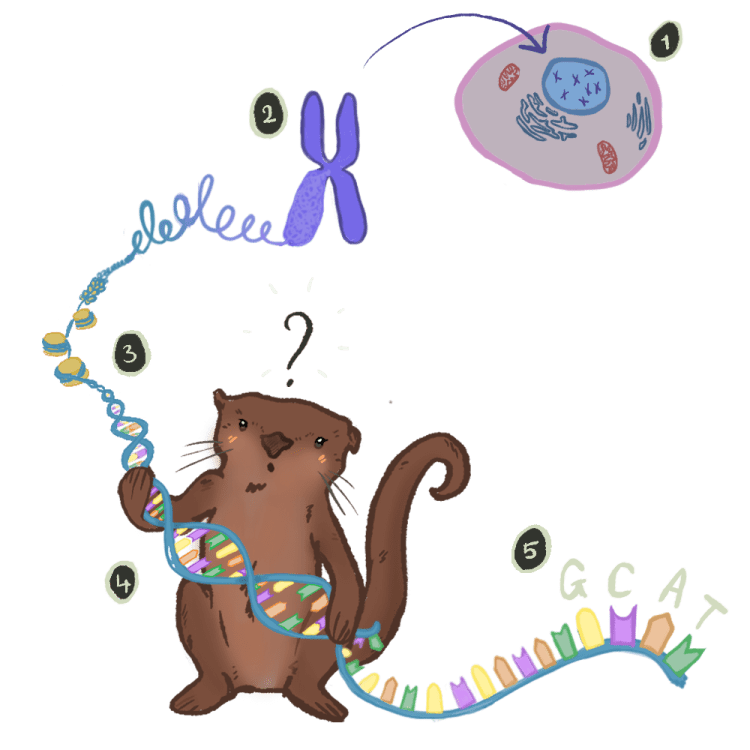
2. This is one chromosome. Each chromosome exists of a long strand of carefully wrapped up DNA called chromatin. So the rolled up strand called chromatin, is a chromosome. The chromatin is sectioned into different genes.
3. The chromatin is carefully wrapped around histones. Histones have an important role, as they determine whether a gene is accessible for reading or not! Sometimes it’s important to prevent a gene from being read at a certain time and place. You can consider histones as little locks, opening up to reveal information, or closing down tight, to prevent reading.
4. When the histone locks open, and the chromatin unwraps, the genes are exposed. The components of the gene, the nucleic bases, now become accessible. We can consider the nucleic bases the letters of the gene, which can be combined to make up words. Nucleic bases are also the connecting points of the double helix as they attach to each other and bind the two strands of DNA together.
5. Each nucleic base can only bind to one other, Adenine to Thymine and Guanine to Cytosine, which can be read in order to make proteins. The proteins are the workers of a cell, and the correct protein-production is fundamental to our daily functioning.
In Otter Words: Your genome can be considered the manual of your being; it describes all the building blocks and builders that need to be created in order for you to function.
In this manual, our chromosomes are the chapters, and our genes can be considered the sentences, in which the nucleotides function as letters.
Some sentences within the manual are more important than others and carry an essential message. An error in a few letters of the manual may for instance may not cause a big difference; we can still interpret the essence of the message. Larger errors, however, may change the entire meaning of a gene, preventing an important task from being carried out.
Curious about how and when these mutations exist? Dive into the deeper mechanisms of your cells in the post about The Birds, the Bees… The Cells, the Genes and the Proteins!
 In Otter Words
One thought on “The Story of Mutations”