When we learn new things, our brain creates new pathways. Whether we engage in physical learning, like practicing the guitar or more studious learning like acquiring a new language or even getting to know a new person. We learn and remember because the connections between neurons in our cell, grow and strengthen. This ability of our brain is called plasticity.
The greek word plastikos, means to have the quality to be malleable. So our brains, being malleable, are plastic-fantastic!
Especially in our “critical period”, the younger years of our life, our brain is extra plastic. There is a lot to learn, and a lot of possibility for our neurons to grow; our brain makes happy use of that. This is why we are able to learn so much in our younger years, and for instance also why it is easier to learn languages at a younger age.
So our brains are malleable, Not in the sense that we all have very different shapes of brains, but in terms of the connections within. This happens in chemical and electrical ways on the inside of our brains.
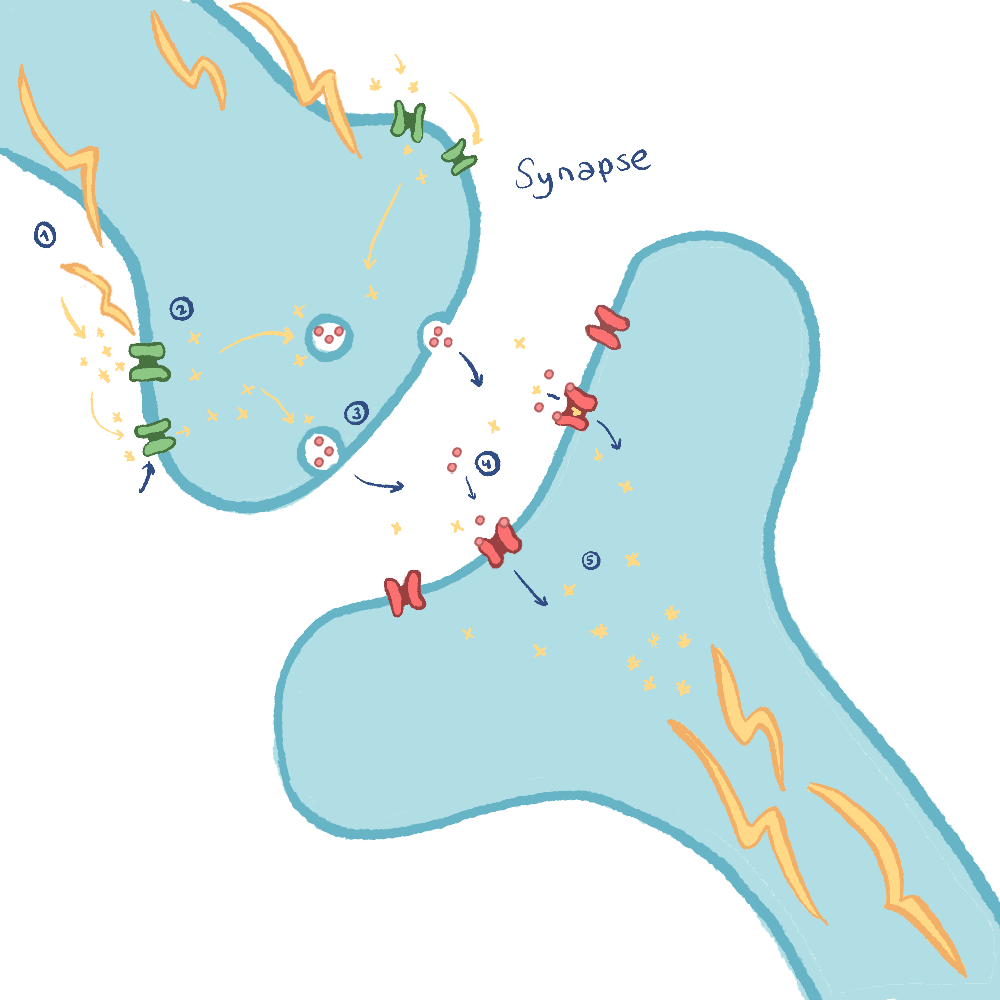
Our brain creates new pathways by creating new connections between neurons in the form of synapses: The word synapse, from the Greek sunapsos indeed means connection, or touching point. The synapse is the point where communication takes place and information is transmitted from one neuron to the other.
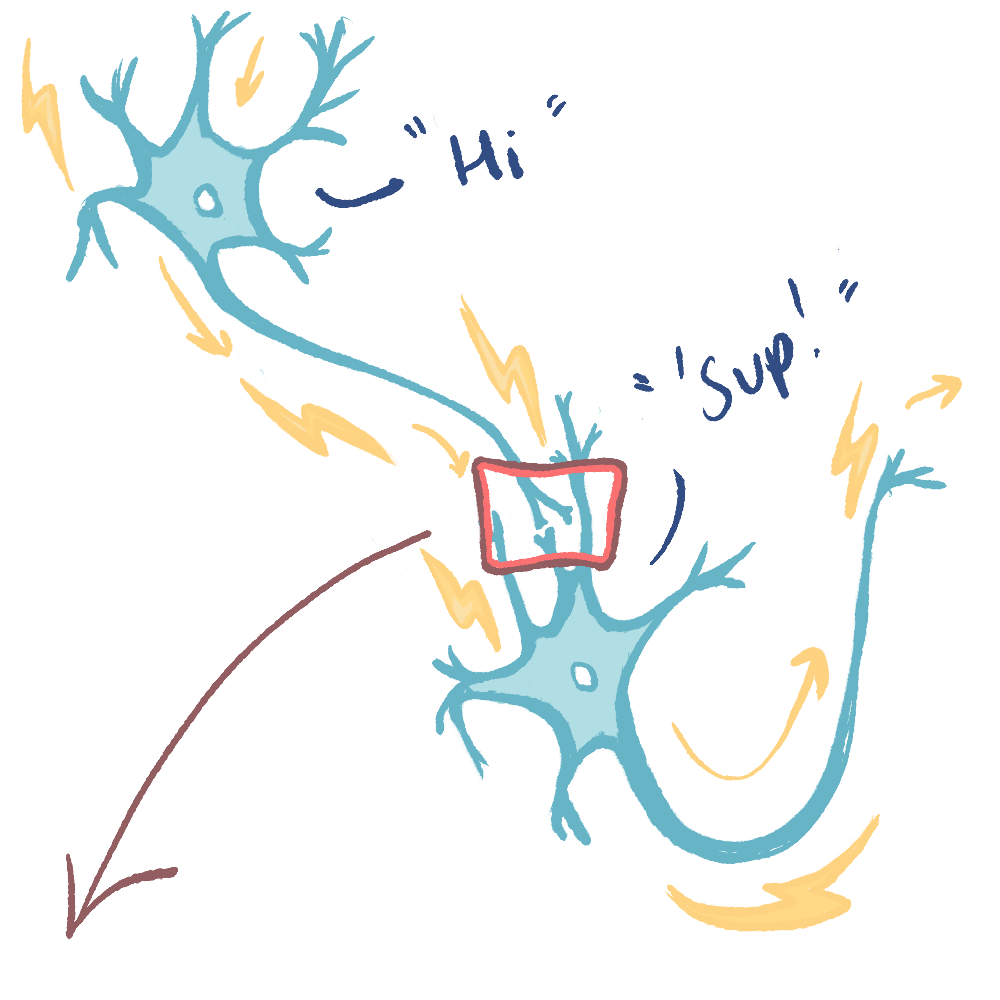
Neurons communicate with each other using electrical signals, which enter through dendrites and exit through the axon (” Say what now?” – Check out this post).
The electrical signals going through a neuron trigger a flow of chemicals, neurotransmitters, that travel between neurons: Through synapses.
Neuronal Communication
Synaptic Transmission
4. Arriving on the other side of the synapse, the neurotransmitters bind to the gate they fit into: Their receptor: As soon as the neurotransmitters bind, the receptors open to continue the flow of the electrical pulse.
When an electrical pulse comes through a neuron, it travels from the dendrites to the axon, where the synaptic terminal is.
The electrical movement causes gates in the cell membrane to open. These gates allow the influx of ions into the neuron.
The electrical charge of the ions triggers the movement of tiny capsules. These tiny capsules enfold the essential part of synaptic communication: neurotransmitters. The capsule filled with neurotransmitters travels to the synaptic membrane, and fuses through the cell wall, so that the neurotransmitters are free to go to the emptiness between two neurons: the synaptic cleft.
When a lot of electric pulses come through a certain connection of neurons, more synapses are shaped to facilitate this movement. Just like we have the need for more lanes on a highway from one important place to another to smoothen the rush hour and prevent traffic jams, neurons build more synaptic terminals to allow smoother communication between brain areas.
So when a certain connection of neurons is activated through electrical signals frequently, it strengthens this collaboration. Like a great neuroscientist, Donald Hebb, once said: “When they fire together, they wire together“. In which “fire”, refers to the electrical impulse neurons send, and the wiring, the connection that is build.
This also means, that when connections are not used as much, synapses get weaker or even disappear: “Use it or lose it“. This process is called synaptic pruning and is also essential, as it allows us to manage our most-used connections efficiently
A whole web of highways is formed of wired neurons, forming the white matter of the brain. They each have the function of connecting different parts of our brain together. And while we learn new connections form and strengthen, and our brain comes completely attuned to the things we experience in our everyday life. And when we stop practicing, the connections slowly reduce, and may disappear. As such, our brain efficiently manages the connections we need, and the ones we don’t need.
In Otter Words: When we practice, in doing or in thinking, our brain practices and strengthens with us. Learning can be seen in the brain; like a tree branches out, new dendrites grow and synapses increase.
We are made up out of millions of cells that work together, and so our brains are as well. The cells of our brain are called nerve cells, or neurons. Neurons are special in their function and shape, each of them are grown specifically for their purpose within the brain. There are a lot of different types of neurons, but let’s focus on the basics for now:
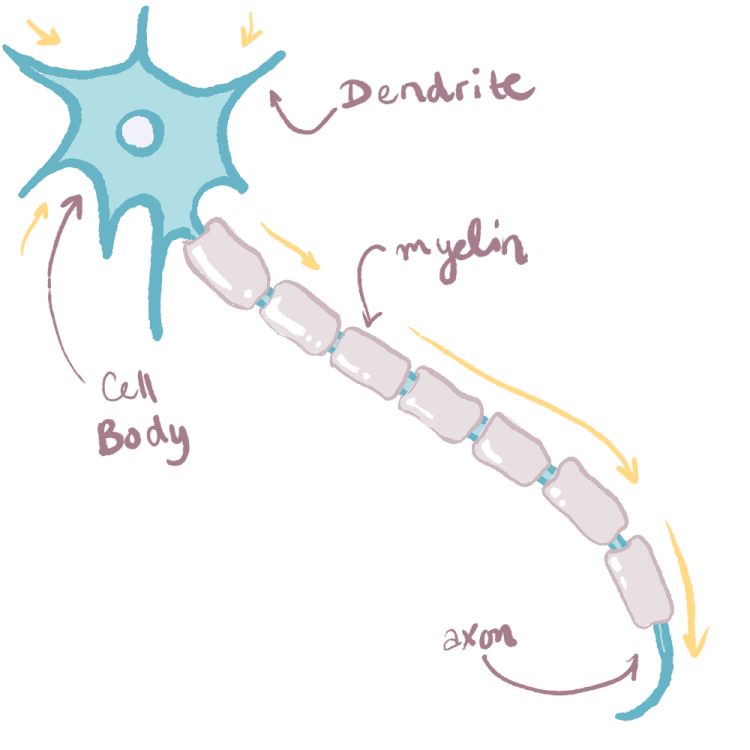
A neuron exists of three important components: A cell body, dendrites, and an axon.
The cell body holds the core of the cell, in which all of our DNA is stored (as you can read in this post about genetics). From the central cell body protrude a few root-like spkes, those are the dendrites. The word dendrite comes from the Greek word “Dendron”, which means tree. Like tree-roots, they receive from the environment. Tree roots take in water and nutrients, and dendrites take in information, in the form of electricity. This electricity enters the cell through the dendrites, and moves through the long end to exit through what looks like the tail of the neuron, the axon!
The axon, from the Greek word for axis. The electric signal that entered the nerve cell through the dendrites can now be directed at the next neuron using the axon.
In the image above it kind of looks like someone got a little too excited around the campfire, and used the axon to pierce seven marshmallows. These marshmallows are supposed to be myelin sheets, and in reality they are not this obviously visible. Myelin is a fatty substance that allows the electric signals traveling through the cell, to travel extra swiftly! Myelin also causes the axon to have a white colour.
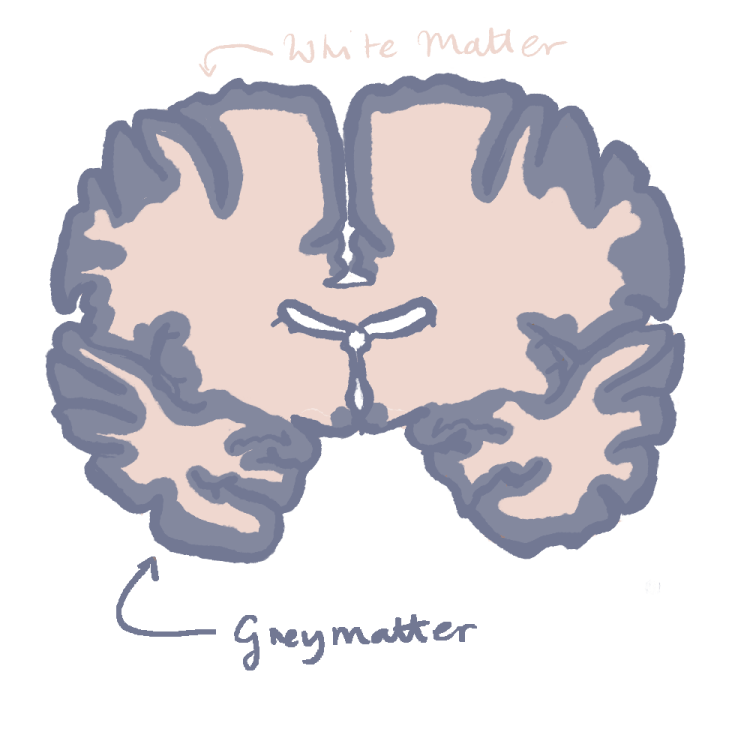
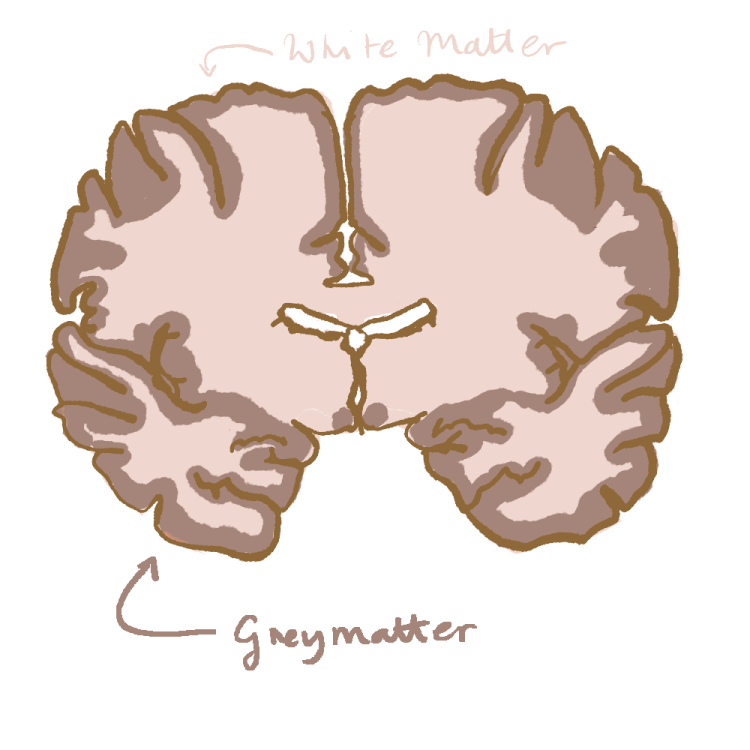
Coronal (crosswise) brain slice
When we cut the brain in half, crosswise (as in the image on the left) you can see this in that we have grey matter and white matter.
Grey matter contains most of the cell bodies and un-myelinated axons. It covers most of the outside of the brain, and has certain islands more towards the core of the brain.
White matter is on the inside of the brain and is white because it exists of the myelin-covered axons!
The white matter is made up out of bundles of axons, connecting different bases of grey matter to each other. There are different tracts of white matter functioning as high-ways through the brain. The tracts connect grey matter centres with each other so that your entire brain is interconnected. They connect grey matter centres within the same brain half or hemisphere, grey matter centres from different brain hemispheres and also connecting the brain with lower centers down the spine.
In Otter Words: The cells that make up our brain are called neurons. Neurons have specialised parts so that they can communicate with each other at lightning speed! These parts are the base and a tail. The base receives info and the tail passes it on. Our brain is even designed in such a way that the bases are mostly on the outside of the brain and at certain islands on the inside of the brain; this is all grey matter. The tails are organised in pathways within the brain, making up the white matter, and relaying information to every corner of your brain.
In the previous post about Intellectual disability, I wrote about my brothers’ diagnosis and the impact this new information had; it was a mutation in his genetic information.
A genetic mutation is a mistake made during the processing and copying of your DNA. It could be very tiny and insignificant in the bigger picture, but it could also cause some fundamental changes.
The popular image of DNA is this double helix, swirling graciously through the picture. We know that DNA determines who we are, what we look like and how our bodies function, but how does this actually work? How does this strand of information drive our existence?
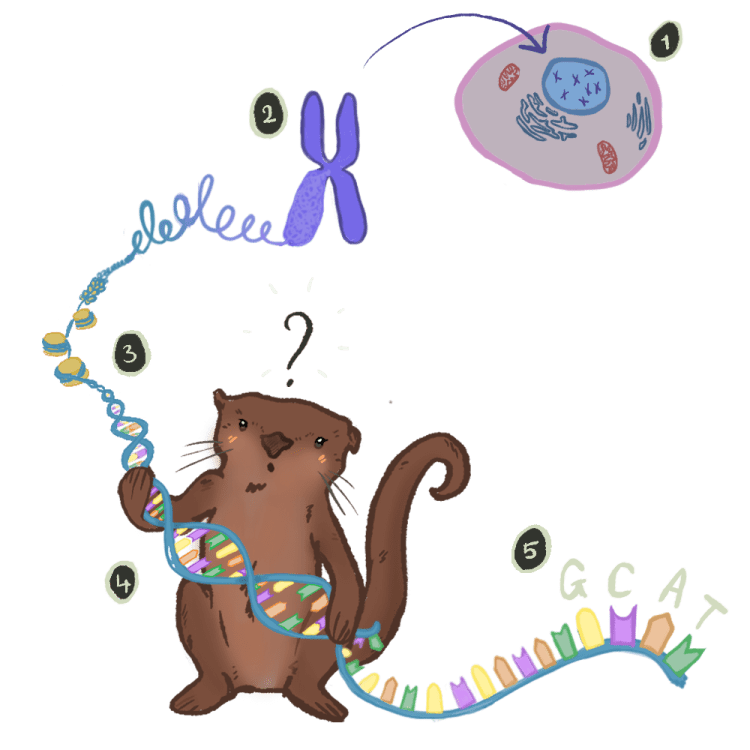
You are made up out of an incredible amount of cells. These cells run all the processes that make you who you are. They can run all these different processes, because in each core of every cell in your body there is a manual, also called your genome. All of your DNA together is called your genome. The genome is incredibly extensive, and is divided over chromosomes, You can see this in the illustration below.
The blue blob in the middle of the cell is the core, the nucleus, the tiny x-shapes inside it are your chromosomes. You have 23 pairs of these. The genome contains information describing what this particular cell should produce and how it should function. Let’s zoom in a little (or a lot).
2. This is one chromosome. Each chromosome exists of a long strand of carefully wrapped up DNA called chromatin. So the rolled up strand called chromatin, is a chromosome. The chromatin is sectioned into different genes.
3. The chromatin is carefully wrapped around histones. Histones have an important role, as they determine whether a gene is accessible for reading or not! Sometimes it’s important to prevent a gene from being read at a certain time and place. You can consider histones as little locks, opening up to reveal information, or closing down tight, to prevent reading.
4. When the histone locks open, and the chromatin unwraps, the genes are exposed. The components of the gene, the nucleic bases, now become accessible. We can consider the nucleic bases the letters of the gene, which can be combined to make up words. Nucleic bases are also the connecting points of the double helix as they attach to each other and bind the two strands of DNA together.
5. Each nucleic base can only bind to one other, Adenine to Thymine and Guanine to Cytosine, which can be read in order to make proteins. The proteins are the workers of a cell, and the correct protein-production is fundamental to our daily functioning.
In Otter Words: Your genome can be considered the manual of your being; it describes all the building blocks and builders that need to be created in order for you to function. In this manual, our chromosomes are the chapters, and our genes can be considered the sentences, in which the nucleotides function as letters.
Some sentences within the manual are more important than others and carry an essential message. An error in a few letters of the manual may for instance may not cause a big difference; we can still interpret the essence of the message. Larger errors, however, may change the entire meaning of a gene, preventing an important task from being carried out.
The Birds, the Bees… The Cells, the Genes and the Proteins!
We now know a little about the build-up of your DNA, and that a mutation or error in your genetic information may have serious consequences for your development. So what actually happened, if there is a genetic cause to a disorder? What took place in your genes that manifests itself as such?
In this post we’ll dive a little bit deeper into genetics. It may be a lot of information, but I’ve tried to keep it as colourful as I could, and of course there will be Otter Words..!
Cell division
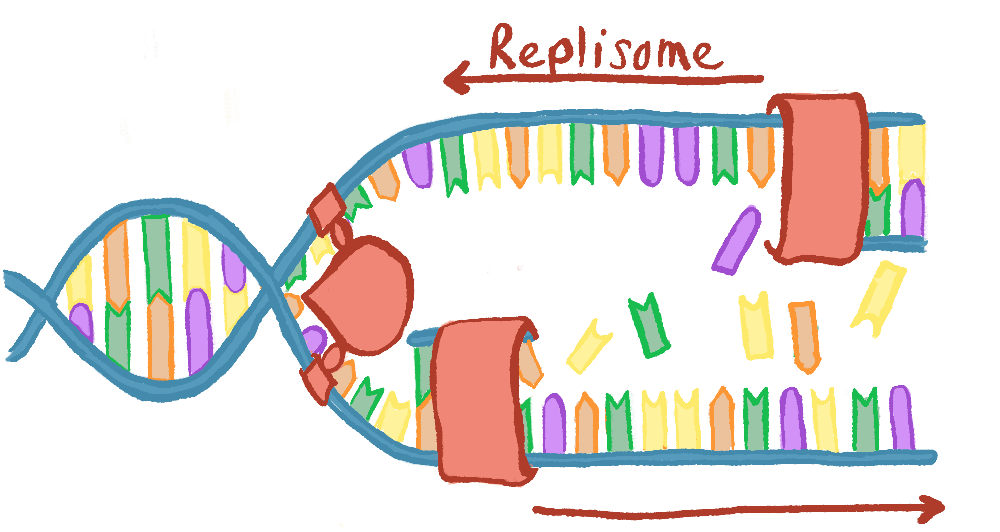
As mentioned earlier, your body is made up of millions of tiny cells. In the lifetime of one cell it passes through several stages. Your cells are continuously cloning themselves in order to make you grow and regenerate! In the interphase (the sort of in between phase) the cell prepares to split it self, and so has to duplicate genetic information stored in its nucleus. This is called DNA replication:
The DNA needs to be unwrapped, so the chromosomes are not all in x-shapes, but instead, there’s a big bundle of DNA helix in the cell core. The beautiful Helix has to split up, as if opening a zipper, to expose all the nucleotides.
This is all done by the wonderful machinery of the replisome: a complex molecular machine that is able to split the DNA helix into separate strands, and creates new DNA molecules to replicate the strand. The exposed nucleotides on each strand can be read, and the matching nucleotide is placed on top of it.
replication
It goes through your entire genome in the nucleus of the cell, until your entire DNA is replicated!
The replisome has great power, but with great power, comes great responsibility… Some nucleotides may not be replicated at all, or wrongly This may not be a problem; it might happen in only one cell of your body, or it may be solved by the cells ‘ preventative and problem-solving methods. However, as you can imagine, one error during the replication of the genetic material may cause the creation of a lot of faulty cells as it goes on to clone itself.
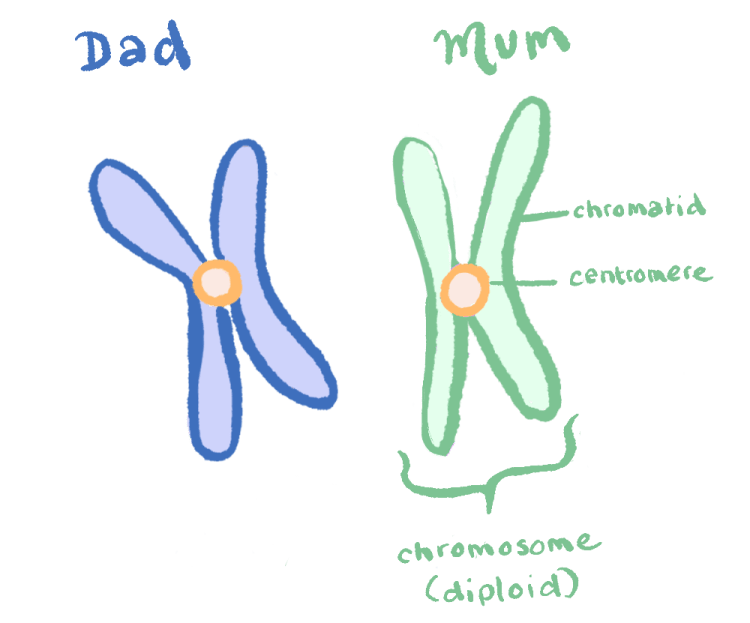
When the DNA of the whole cell is replicated, actual cell division can take place! This is called meiosis. there are a few more stages. In a few stages, your 46 chromosomes are split up and divided equally to the opposite side of each cell. You can see 2 sets here, but actually there are 23 from mum, and 23 from dad). It’s an interesting process as you can see below.
Each chromosome is split at the centromere, and its chromatids are pulled to opposite sides of the cell. When the chromosomes are equally divided, the cell splits, making two identical daughter cells.
However, the mutation that caused a developmental disability
did most likely not occur during mitosis. The process we need to look at in
this case is meiosis.
When you are created as a baby, you are created from two sex
cells; a sperm cell from dad and an egg cell from mum. These cells are special
since they have all the genetic information that all of your cells will be
based on, the blueprint of your entire being! Sex cells are made during the
process of meiosis, and are cloned from other sex cells. Imagine a tiny mistake
made then! All of your cells cloned from this cell will be based on that
initial faulty egg or sperm cell.
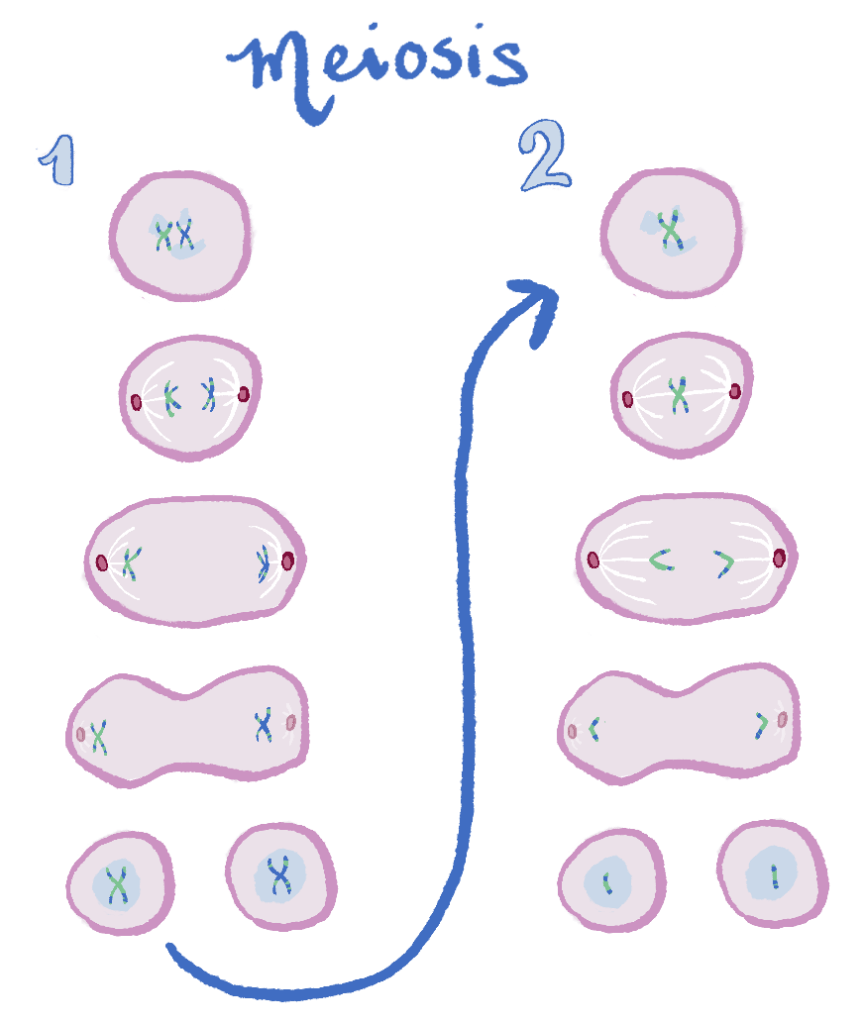
A cell in meiosis goes through all of the steps that a cell
in mitosis, but twice!
Homologous Recombination
The difference is in two parts: At the start of the process, before division, your chromosome from dad and your chromosome from dad meet each other. These pairs can then exchange some genetic information.
Since genes for a specific role are in one specific spot on a chromosome, for instance the genes that determine your hair color, this exchange can take place easily when they are alongside each other. This is called homologous recombination.
The initial cell with double the genetic information goes through cell division twice, so that eventually four unique haploid daughter cells are created! You can see the process of meiosis in the image below, where only one set of chromosomes is displayed.
Often the severe types of intellectual find their cause during this process. As the sex cells are the foundation of an individual, a mistake made during the cloning of your genetic code will be represented in all cells of the body.
In Otter Words: Your cells continuously clone themselves in order to make your body grow and heal. Especially during your early development it is important that all these little steps are executed properly. A mistake in this can cause the mutated cell to not function properly. If a mutated cell is still able to clone itself, a large percentage of your body consists of these faulty cells. How early such a mistake takes place, can affect your development immensely.
Protein Production
When a genetic mutation causes a disorder, one part of the gene is mutated so severely that it loses it’s function: the protein that it was supposed to code for, cannot be made anymore:
Proteins are made outside of the cell core, so outside of the place where all the DNA lives. A type of messenger needs to be made from the existing DNA in order to tell the outside world what needs to be made. This messenger is RiboNucleicAcid (RNA).
When a gene is accessible, it can be copied from DNA into the RNA.
This is done by a certain enzyme called an RNA polymerase: it attaches itself to the start of the gene, and moves along it like a train across the rails while reading the letters of the gene, just like during replication. The nucleic bases are read by the enzyme, as it collects mRNA bases to make a matching strand of messenger RNA.
But when the new nucleotides are collected to make the messenger RNA, instead of Thymine, Uracil is added in.
The presence of Uracil in an RNA strand, indicates that that particular strand is a messenger.
Messenger RNA is the messenger of the manual of your body: It holds the exact instructions to what proteins should be made.
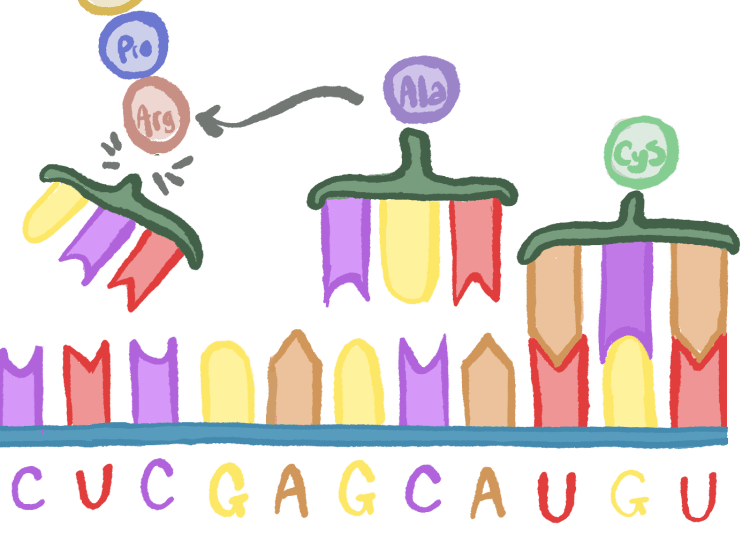
So when the messenger RNA is fully transcribed, it travels outside of the cell nucleus and floats around until a Ribosome comes by. A Ribosome is a piece of machinery that recognises sets of the nucleic bases per set of three.
Protein Translation
The ribosome reads the messenger RNA per three bases, and calls transfer RNA to bring the fitting amino acid. This process is called translation, as it really translates the combinations of nucleic bases into an amino acid. The amino acids are strung together to make the protein that the gene was meant to make!
While there are only four nucleic bases, in pairs of three the different combinations give the possibilities to about twenty amino acids. In one long chain of amino acid combinations, it makes up a certain protein.
And so this is how a genome instructs cells to produce the proteins we need to function! This may be a slightly simplified version, as more tiny intricate steps are necessary, but this is what it comes down to.
A genetic mutation early in your development can prevent an important protein from being made in a large part of your cells. Depending on the role of this protein, it can affect your functioning or even your chance on survival.
The gene that was mutated in my brothers’ DNA codes for a protein that is part of a very large protein-complex. This complex is responsible for determining which genes are open to be read, and transcribed into RNA. Therefore, this mutation directly influences a very fundamental aspect of your DNA and how it is read, having a widespread effect on his entire development.
In Otter Words: A lot of steps are necessary to turn the information within your DNA, into the functioning building blocks and working machinery of your body. Your DNA first needs to turn into a messenger version in order to be read, this messengers spreads the manual of your genetic information outside of the cell core. There it tells other workers of the cell how to make proteins. If one part of your DNA cannot be read properly due to a mutation, it has a cascading effect so that one or multiple proteins cannot be made in the right amounts and will not be able to function correctly.
There are a lot of different important variables that may affect the severity of a genetic mutation, such as when during development, where in the genetic information and what that gene was supposed to do.
I am a middle child, raised between two very interesting brothers. The oldest one is highly intelligent. The youngest one is intellectually disabled. Since this post is titled Intellectual Disability, you might’ve guessed that I will be writing mostly about Mr. Younger Brother.
Perhaps, I’ll write about the elder too, one day, since he undoubtedly also has a fascinating brain.
The younger brother is 2 years my junior, and we happily grew up together. Back then, I never really grasped the fact that something had caused him to be “different”.
I did understand the fact that our parents payed him extra attention, as he needs more guidance in everyday life. I also paid extra attention to this myself, to take care of him and to make sure that he was content and safe. I also wanted to ensure that people around us understood the situation, and weren’t intimidated by something that might be odd for them. However, never before did I realise, the immense concern that my parents must have felt after he was born. That something was wrong with their newborn child, and that his health might be at risk.
While my parents had numerous hospital visits, scans, and other measurements we never received a diagnosis in the first 22 years of his life. Countless times a neurologist just could not tell them with certainty that there was indeed a developmental issue. Eventually, all the studies and examinations lead to the conclusion that he had probably suffered from oxygen deprivation in the womb. Based on the brain scans my parents were given “a diagnosis”.
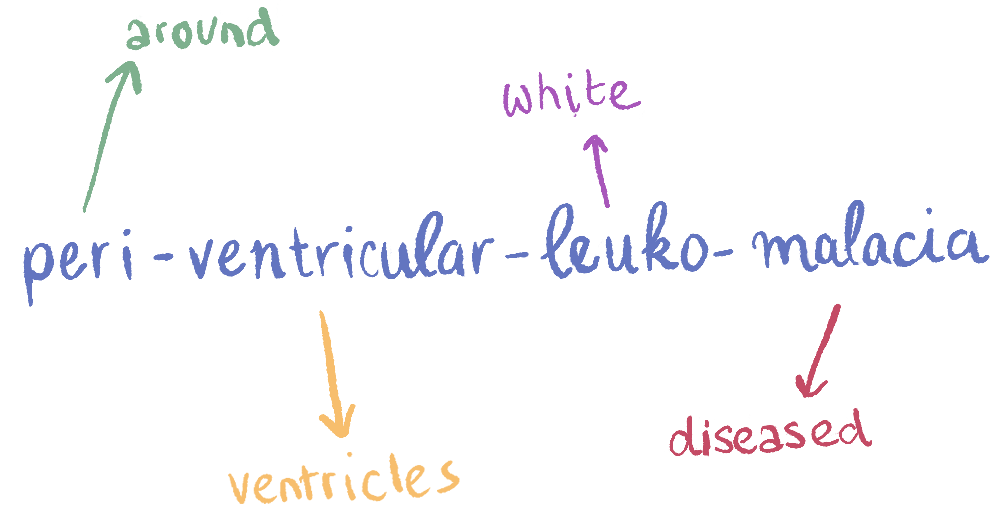
Periventricular Leukomalacia
A superduper complicated word if you look at it like that.
So let’s tear it apart:
Peri means around and then there’s ventricular, which indicates the ventricles, the cavities of the brain, so something “around the ventricles”.
Leuko is white, and malacia means diseased.
Which comes down to: around the ventricles white diseased…
In Otter Words: There is something wrong with the white brain matter around the ventricles.
Cerebral palsy, damage to the brain, due to oxygen deprivation.
A brain’s grey matter is the darker outsides of the brain. You could compare it to the brain’s headquarters, as it is where all the cell bodies of the brain cells lie.
White matter is the big highway between brain regions. In earlier times, it was thought that white matter wasn’t very important, but it is a huge communicative relay within the brain!
The white matter is whiter than the rest of the brain because it contains al the myelinated axons. Axons are the part of a nerve cell through which messages are sent from the cell bodies. Myelin is a fatty substance that envelops the axon. The myelin sheath around an axon, makes transduction of electrical communication between nerve cells faster, and gives a white fatty colour.
So, periventricular leukomalacia: something was wrong with his white brain matter… In neurological terms a very, very general observation, as it actually did not give a real explanation of what actually was wrong.
Still, it sounded intricate and impressive. So, whenever
someone asks me what my little brothers’ exact disability was, I would proudly
recite the difficult word. Picture this: A 9 year old teeny tiny girl belting
out…
“PERIVENTRICULAR LEUKOMALACIA!”
with a slight lisp.
This usually resulted in people looking a tad frightened. So then I just started to describe how my little brother was different from the norm:
He couldn’t speak, but he could walk. Even though at times it looks as if it might be a little difficult for him.
More precise controlled movements are more challenging, like those needed to pour yourself a glass of milk, or to use cutlery.
He drools sometimes, when he’s trying to focus, or when he’s
not focusing at all…
He isn’t “potty trained”.
But he’s incredibly social, understands everything you say to him as long as it’s not too complicated for a 5-year old to understand. He is highly empathic, and feel emotions very strongly himself as well. He is able to play board games now, rolling the dice and already planning who he can kick off the board. He uses music to communicate his thoughts and feelings, navigating through Spotify to find the fitting song. Therefore, I believe he can count, and I believe he can read. Just not in the way that everyone else might have learned it.
For many, intellectual disability is a difficult topic to talk about. But I’d like you to know that I never experienced it as something sensitive, or as a touchy subject. My brother was of course not “something we did not talk about”. He brings our family to the next level; it teases out an open-mindedness and perseverance you need, when growing up in such a situation.
In Otter Words: I’d like to think that we could often learn a whole lot from individuals with Intellectual Disability. Of course, it is a limiting condition, that may affect your health and functioning, but I also feel like it offers a new perspective on goals in life. Rather than solely aiming for the highest level of education, job perspectives and such, you seek out health and happiness. Allowing you to value all the other extra bits that life is able to offer you, regardless of your limitations. Still, intellectual disability has an odd image in society.
The Image of Intellectual Disability
The cause of a disability can be something induced by ones’ environment, such as a traumatic injury, or something genetic. The nature nurture divide, if you will. In this section I will talk about the genetic cause of intellectual disability.
In earlier times it was not known that a disability could be a consequence of your genetic makeup, and therefore different reasons for someone’s defect were thought of: It was something that was dealt to you by God, for instance, to teach you. It was the fault of the parents, or the medic at work. Early psychology even liked to blame a mother’s behaviour for a dysfunction of their child.
We are starting to understand the mechanisms behind these types of conditions. That there is no higher power casting a curse, and that it solves nothing to blame someone for it.
Genetic research is thriving. Scientists understand the composition of our genetic makeup, the way it is constructed, and the way it determines our phenotype. Consequently, it makes it possible to tell when something within our genetic makeup has “gone wrong”. It is therefore also now that new syndromic intellectual disabilities are being put on the map rapidly.
This is also why, a little over a year ago we finally received the real diagnosis for my brother’s disability. My parents had been called in again, and were informed that the genetic sequencing had been improved significantly since the last screenings. With this information came the question of whether we’d like to be checked again, as a family.
We agreed to participate in this new screening, as we thought it would rule out any genetic factor. We thought we could dismiss stressing about passing on “faulty genes” if I, or my older brother, would have kids one day.
It was all to rule out something genetic, but then my mum was called.
She was told that her son indeed had a genetic mutation. It was located on the so-called GATAD2B gene: an error in his genetic code had caused for him to be like this. At that point in time, he was the 100th diagnosis in the world and the 10th in the Netherlands. The syndrome had been described in Nijmegen, the Netherlands for the first time in 2013. Very close to home!
Only a month later we got introduced to an entire new group of people, who had faced similar challenges and joys as we had. One of their family members, their child or sibling had also had the GATAD2B mutation, and was diagnosed with GATAD2B Associated Neurodevelopmental Disorder, in short: GAND.
The Use of a Diagnosis
You always think your brother is unique; you resemble each other a bit as you are siblings – but his facial expression, the way he smiles, the way he looks and moves. That is something unique, right? Imagine finding out that he has a type of syndromic intellectual disability that does not only cause cognitive and physical challenges, but even facial features that are called “dysmorphic features”, described as:
A
tubular shaped nose,
Narrow
palpebral fissures (a narrow opening between the eye-lids),
Thin
hair,
Periorbital
fullness (fullness around the eyes),
Strabismus
(eyes are not aligned properly: cross-eyed),
Long
fingers
Hypertelorism
(increased distance between eyes),
A
short philtrum (vertical piece of skin indentation between nose and upper lip)
and
an often present grimace.
We recognised my little brother in all of these other individuals with GAND. The younger kids looked exactly liked he did, back in the day. And a slightly older young man, 28 years of age, was so incredibly similar to him.
With tears in our eyes and goose bumps on our skin we started to bond with other parents and siblings over our experiences. Finding out about matching symptoms, developmental curves and even character traits! We could laugh together about typical quirks, and their love for peculiar games and objects. We could share solutions for everlasting challenges, such as brushing teeth and potty training.
You realise then what an early diagnosis could actually do for parents.
My parents had no idea about the typical characteristics of GAND, and as such had no specific way of preparing for a future or a targeted therapy for my brother. While they were in uncertainty for such a long time, they attempted everything within their ability to make sure my brother would have all the chances that he might need to grow.
When children don’t display the type of behaviour at a certain age that is expected, parents start looking for an explanation as to why: It might start at the way a baby makes social connection, the way they make eye-contact for instance. Early symptoms may be disregarded as it could be a phase they grow out of. Then a-typicalities may become more physical, for instance when a baby is not able to sit up straight, or to crawl. Perhaps it becomes really obvious when language skills do not develop at all. As soon as a developmental delay becomes noticeable, be it in physical or cognitive development, question marks arise.
Families with young children diagnosed with a disability can be informed about the cause, allowing them to prepare for a future. They can build a supportive network together with those in a similar situation; compare their kids’ behavior, talk about struggles and achievements, and about their developments in life. These families are the important ones to track the course of a genetic syndrome and its’ actual phenotype.
As the gene sequencing technologies have developed immensely, it has become much cheaper and faster to decode the essence of your genetic code. That is why not only we had the chance to receive a diagnosis, but many other families as well. Consequently, a whole lot of new syndromic genetic disorders have been classified. This also means that a lot of these syndromes remain just un-described gene-codes. Describing the behavioural and physical symptoms of a genetic syndrome is incredibly challenging. It requires a lot of effort and dedication. The clinical world is working hard to describe all the newfound genes, in order to support families with a new diagnosis.
In Otter Words: Knowing a causal mechanism of a disorder such as intellectual disability, and the fact that it’s syndromic, allows for us to understand a certain behaviour or limit of that individual. It may offer a sense of acceptance and relief. It may resolve the question of guilt. Finding others with the same genetic disorder with similar traits and symptoms, is a great help. As the real experts on the topic are family.
Humans have more often thought of what it would be like to be an animal. A philosopher called Thomas Nagel once wrote an essay about it: “What it’s like to be a bat”. In his opinion we will never be able to find out what it’s like to be someone or something with a different brain, because there are certain ways of looking at the world, or methods of perception, that we will never experience. We won’t know what it’s like to have sonar, or what it’s like to fly or anything like that. Even with our modern ways of measuring the brain, he argues, we will never know the real feeling.
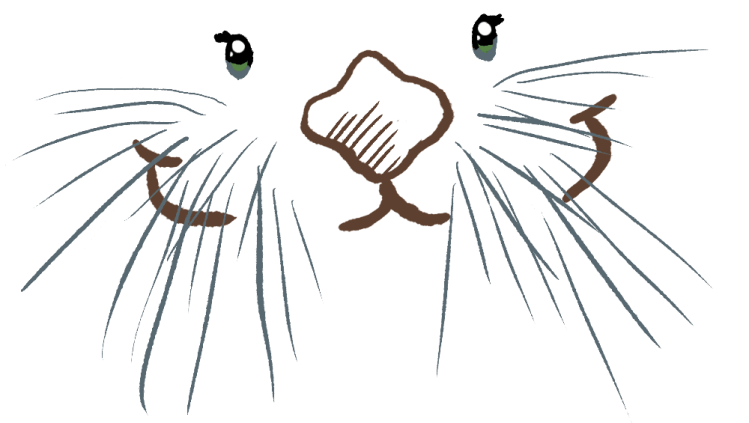
Take the whiskers of an otter for example. A typical otter has about a 120 of these strong, sensitive hairs on their muzzle. They are not like our normal everyday hairs, with which we sense touch and temperature. These things are supersensitive to currents, air, and touch. The beard and moustache have re-gained popularity in human males, their modern-day function remains, while fluffy and warm, mostly a fashion-statement and the otter mystacial (Merriam Webster: having a stripe or fringe of hairs suggestive of a moustache ) serves a different purpose.
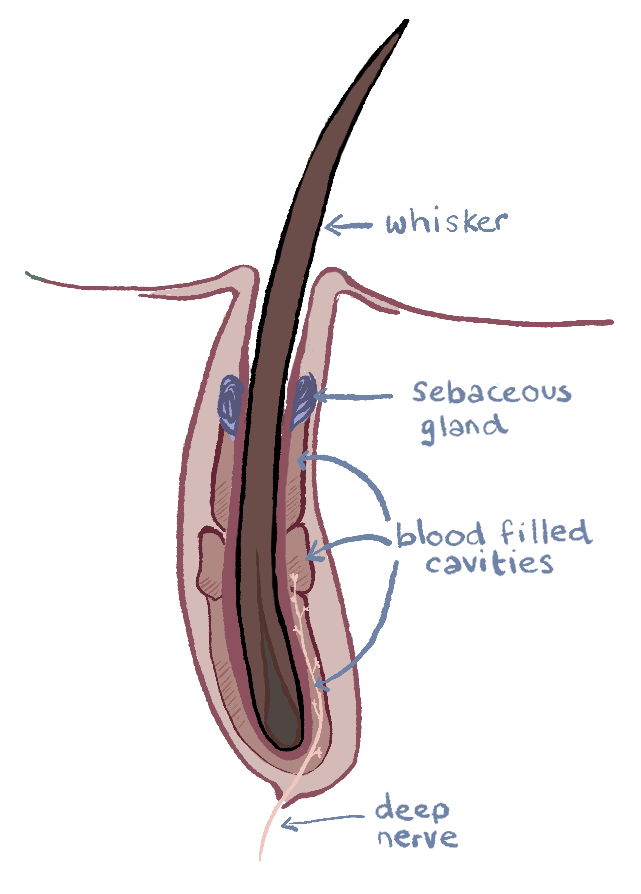
So how does Otter actually gain anything through whiskers? For that, we need to understand the detailed anatomy of the whisker and how it’s embedded into the muzzle. The root of the hair is surrounded by three blood-filled cavities, which are enclosed in a stiff capsule. In the top one cavity, you can find the sebaceous glands: This gland excretes oil to add an extra waterproof layer to the skin.
At the bottom of the entire capsule, a nerve enters. This nerve innervates the entire capsule, and takes all the sensory information from the whisker to the brain. So when the whisker is moved by wind, water or any other type of thing that causes motion in the cavities, this innervates the nerves and sends that information to the brain. Specifically the sensorimotor cortex of the brain. This is the part of the where sensory information from the environment is received and coordinated with outgoing motor actions. It is important that all this information travels and integrates swiftly, as an otter needs to respond quick and stealthy; hunting for fish and fleeing for bigger predators.
Therefore, all the sensory information coming from the whiskers should be relayed super fast! Luckily, the deep nerve brings information from about a 1339 myelinated axons per whisker! This makes the whisker very sensitive, and communication of tactile information very fast. A 120 of these whiskers inform Otter about everything happening around her…
An Otter Brain
While Mr. Nagel has a point; We would have no clue what having whiskers would actually be like, humans are pretty good at simulating certain sensations that are characteristic for specific animals: like flying or locating other people using sounds, think of Marco Polo… The brains of other animals are wired differently, to allow for things like sonar and whiskers. The evolution of different species’ way of living and environment has made sure that our brains are in sync with the body that we have. Therefore, we may be able to better understand some types of behaviour through looking at the brain, its’ shape and activity, and comparing this to our own.
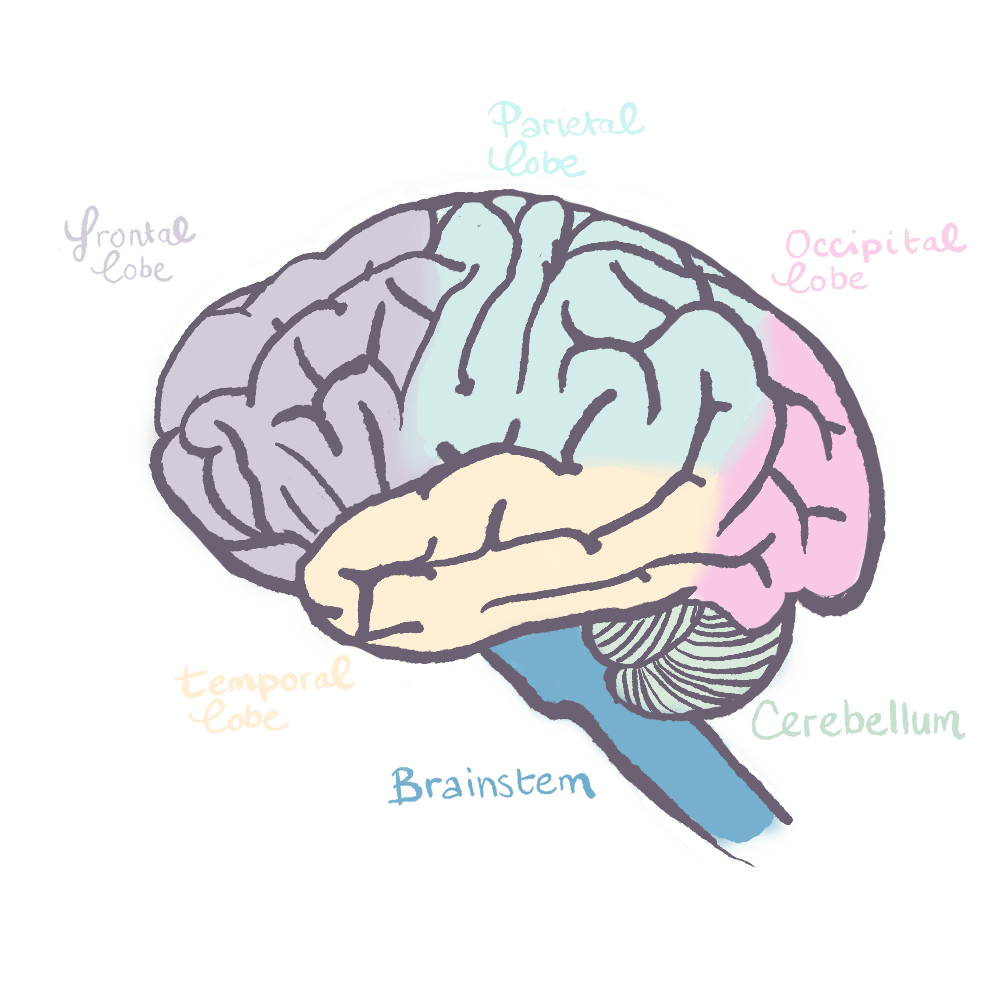
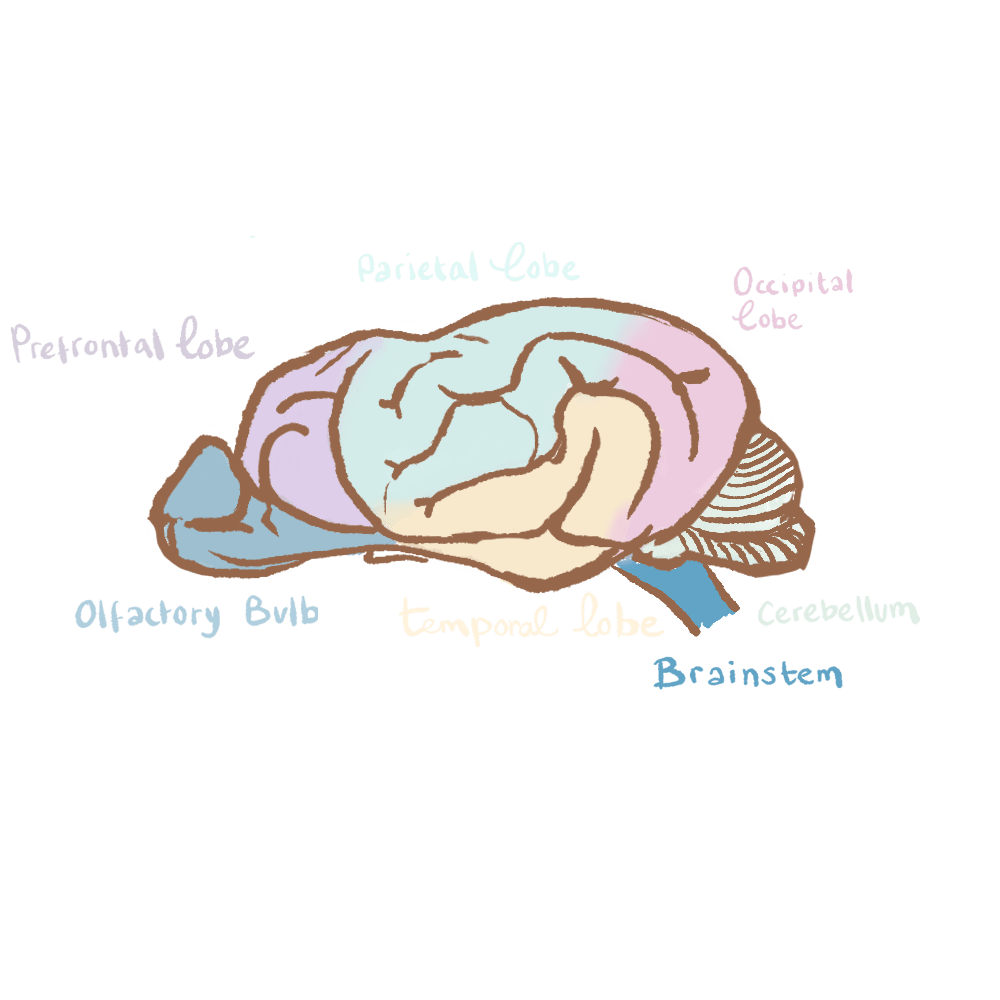
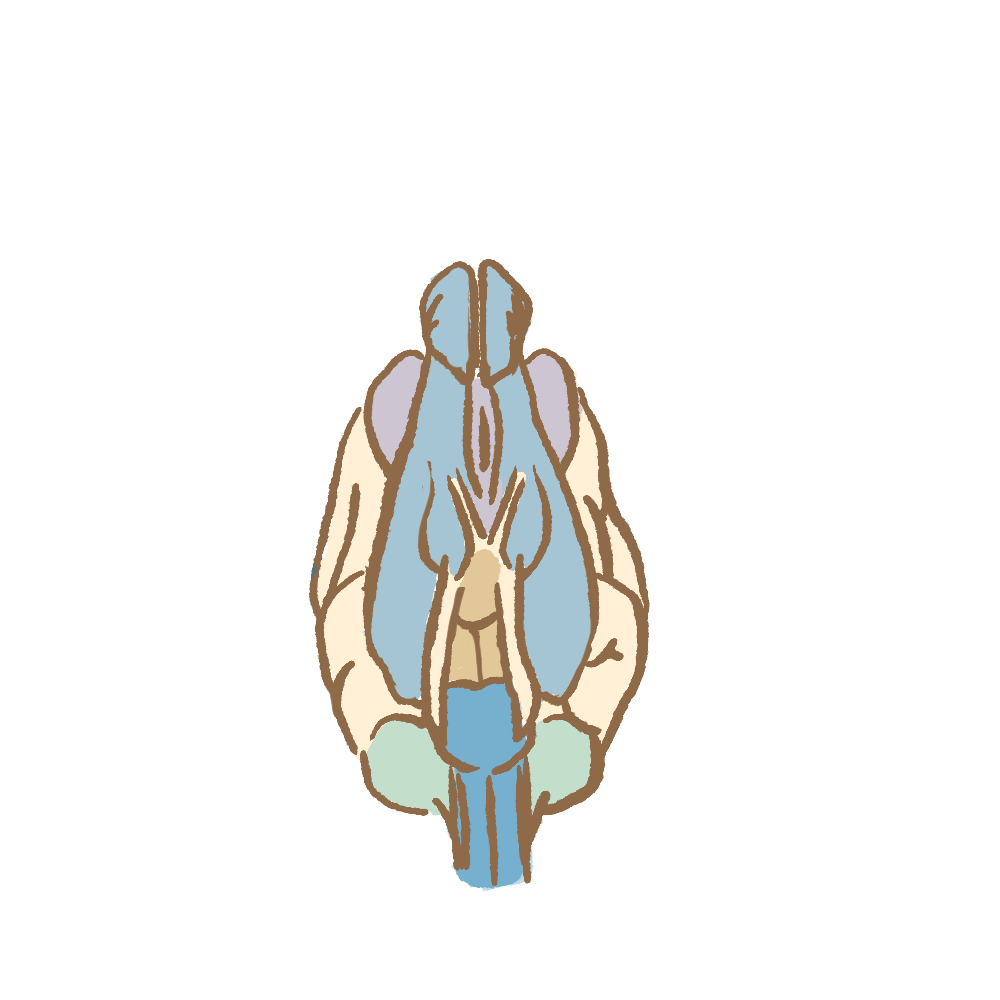
For example, we can compare brain regions with a similar function, in different species’ brains. These are called analogous regions: We can make assumptions about the size of a certain region, and the shape, and how it affects a species’ behaviour and perception of the world. While we will never know what it’s like to be an otter, we can try to imagine.. Let’s look at the brain of a human, and the brain of an otter. After foraging for any clues about the appearance of the otter brain online, I managed to find a very old veterinarian journal from the 70’s, with an article dedicated to exactly this! Epic findings = epic day.
Looking at these, we see that we both have the same brain regions, but the first noticeable difference between the human and otter brain lies in size and shape. These illustrations won’t be exact representations of the brain and their ratio in size, I apologise. I imagine that the otter-brain is not much larger than a lemon, while the human brain is about 1200 cm3. We have a much larger brain, which is logical since our head is about four times as large. On top of this the Otters’ brain has a different shape. While the otter brain is quite elongated, the human brain is bulky and rounded.
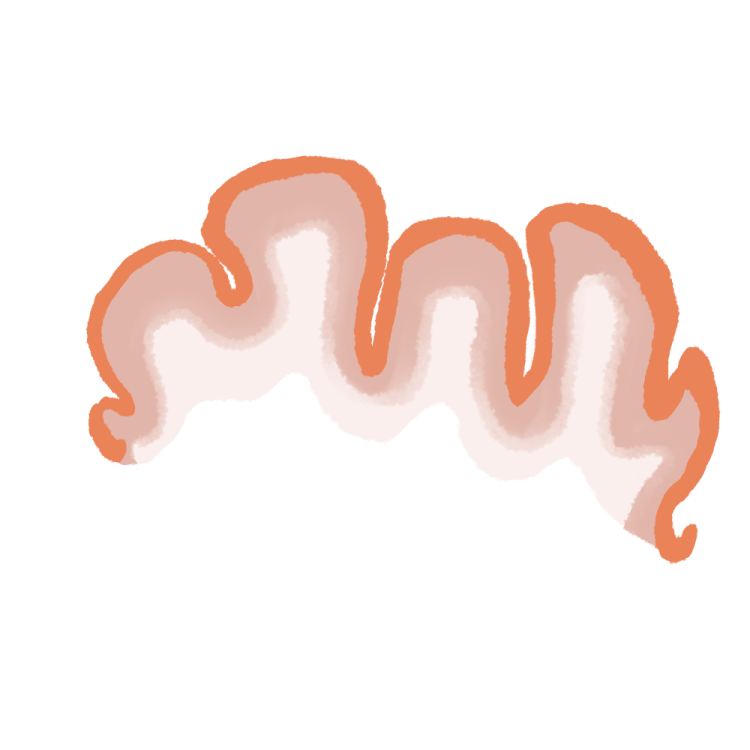
It’s important to keep in mind that we cannot deduce an animals level of intelligence by looking purely at the size of the brain. While it is more useful to look at the relative size compared to the size of the body, this is also not a direct indication of complex behaviour. The folding of the surface of the brain, called gyrification, is a better estimation as this indicates the surface area of the brain. However, there are many factors influencing intelligence and brain function, including the speed with which brain cells communicate and the relative size of certain brain regions.
Gyrifiation
The brain is such an intricate organ, and still contains many mysteries for us. That is why we still need to link brain to behaviour and see whether we can speculate on one, using the other!
The frontal lobe, which is important for executive functioning (things like attention and memory), is very developed in humans. This part is also called the “new brain”, an important feature that I will come back to later.
Another important observation is the size of the olfactory bulb. The olfactory bulb is the region of the brain where information of smell is received before it is further integrated in other brain areas. We, humans, barely have an olfactory bulb. The otters’ olfactory bulb is very large compared to the rest of the brain, and even sticks out at the front! This may suggest that the perception of an otter is highly influenced by smell.
The parietal lobe of the otter is quite developed. An indicator of this development may be the gyrification in that area. Especially the somatosensory cortex, a part of the parietal lobe where the information from the whiskers and the nose arrives! That makes sense doesn’t it? Some extra gyrification and more communication within the somatosensory cortex, may be an indicator for more intense processes going on in that region, which can be linked to the otter’s exceptional sense of smell and tactile abilities.
In Otter Words: By looking at the brain, the activity of the brain and certain behaviours of an animal and comparing it to others’, you can try to connect functioning to location. It is still a very mysterious topic, of course, because it is difficult to know what’s going on in their mind with certainty.
The Otter & Otters
Otters function nicely in social groups and sometimes even in cooperative hunting and problem solving. This is a trait that is also very rare in animals. We, humans, are considered to have developed this huge new part of the brain other animal-species don’t really have. This is because we can make a lot of social bonds. Being social, and having several social relationships is thought to be related to the size of the Prefrontal Cortex. This also happens to be the part of the brain that is important for “executive functioning”. Executive functioning sounds important, because it is. These are the skills you need to process information, and to act on it. Such as your memory, your attention, impulse control and organisational skills.
So otters are pretty social. River otters a little more so than sea otters. River otters also tend to look further than their own species to make friends. Like in this video, in which a river-otter longing for a belly-rub tries to make friends with a deer
So, better executive functioning may also lead to a bigger frontal lobe (or vice versa) and to the ability to retain more social relationships. You still see a much larger frontal lobe in humans, and I have the feeling that over the years this may develop more and more: Our social networks are growing larger. We are able to maintain contact with people that we met in far-away places, and people we met years and years ago, through social media. The amount of people we know and keep in touch with is astonishing, and I expect this to have great impact on our brain functioning.
Otters like to socialise, but on a different level than humans. River otters often hang out and hunt in groups, sticking around with mum. Sea otters go out to hunt on their own, but hang out together. They do this in single-sex groups, the floating sea otters together are called rafts. Lounging in their sea-rafts, otters also often grab each others hands to not drift off. All the while being adorable and social in this action, it also shows that otters use can cleverly adapt their environment in their advantage; They don’t only use each otter but also all the kelp they can find and wrap it around them to prevent drifting away from the raft out into the open sea
The Nifty Otter
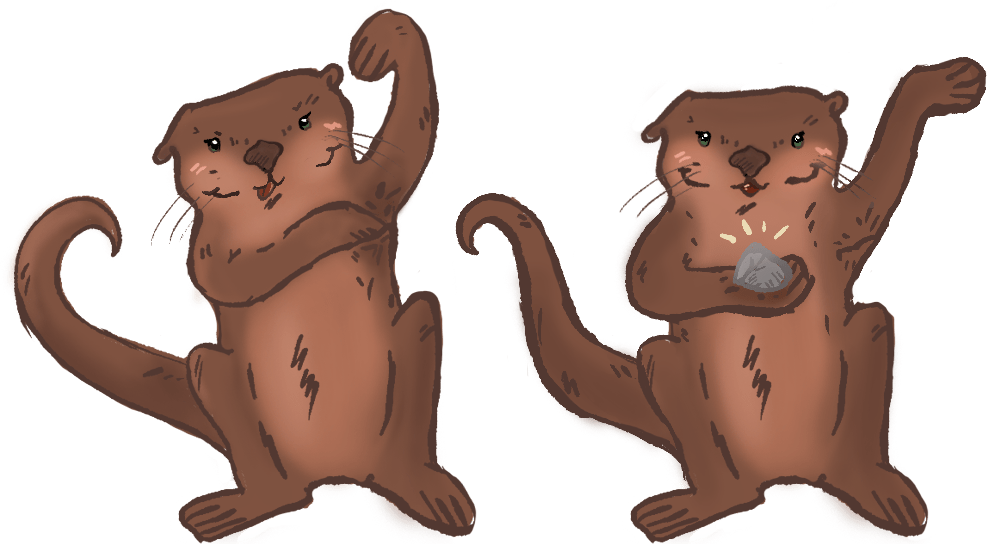
The use of kelp shows that otters are one of the few species that, like humans, use tools. Even more importantly, tools or also used for hunting: Otters use rocks to bash open clams. You might never consider this, but intentionally grabbing one item, like a rock, that doesn’t seem particularly relevant to your immediate survival is not very logical. So the fact that otters are capable of making the in-between step to value something of indirect use to them, is very impressive!
“Hey, a rock! Epic, I can use that to open this clam I’ve been holding on to!”
If they happen to have a favourite rock, they can even store this, along with some food, under a flap of skin in their armpit. How great is that? Imagine having an extra pouch underneath your armpit to hide your spork and snacks…
Anyway, the use of tools is considered highly innovative in the animal kingdom. We started doing this to transport stuff, to make a fire, to hunt, wage wars etc. before we grew out to be the species that conquered the entire planet.
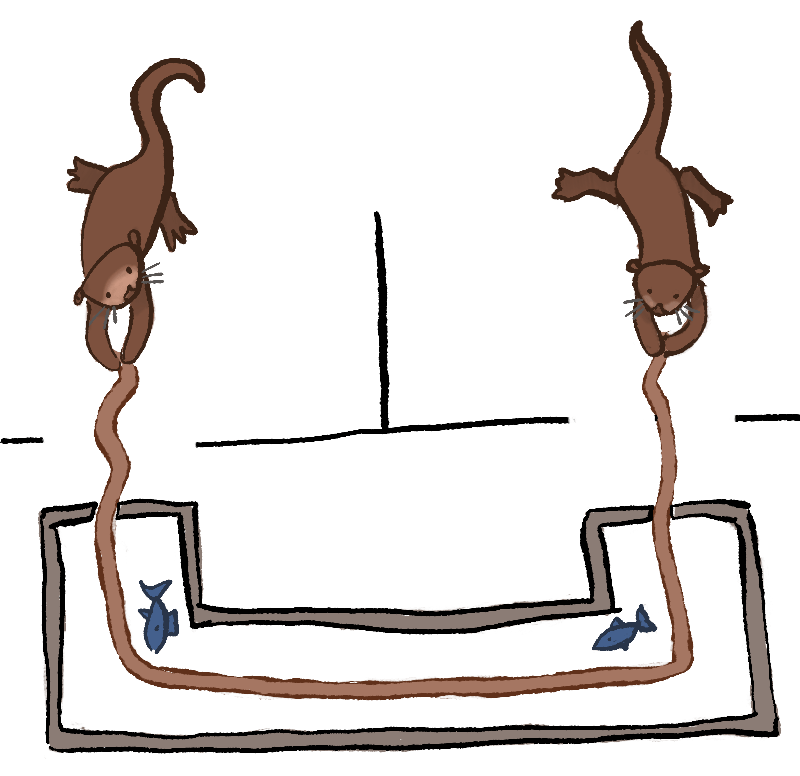
Another interesting task to test both an animal’s social and tool-using ability, is the “Loose-string-task”. Luckily for me, this was also done with river-otters. In the task the otters need to cooperate in order to get a treat, which in this case was a fish. The otters were taught to pull a string in order to haul in their reward. In the version where their cooperative capabilities are tested, an extra player comes in. The otters need to coordinate their actions: pull the rope simultaneously to haul in a prize for both of them. If one otter proceeds to pull the rope in a self-centered manner, the string will also be pulled out of reach for the other otter, making it impossible to retrieve any of the fishes.
Loose String Task
This tests the ability of an otter to use a tool for a reward, like it does with the stone: “If I pull this rope, I will get a treat”, but it also requires them to take anothers’ perspective on a task: “This other guy also needs to pull the rope, and I need to pull only when I see he will do that too” . This perspective taking is brought to the next level in the delayed version of the task, in which one otter is allowed in the area where the rope is before the other otter is… This may cause issues with inhibition-management. As the pulling of the rope is already related to reward. The otter now needs to control the urge to already pull the rope, wait, and thereby realise that his otter-partner is essential in this task.
Both species of otters, the river and sea otter, were able to complete the task. However, they performed a lot worse in the delayed version of the task. This indicates that while they have the ability to coordinate their actions, they cannot inhibit their urge to pull the rope enough to coordinate with their partner. For these types of lab-based tasks it is important to consider the factors that influence the otters’ performance. Their environment is not their natural habitat, and the partner they cooperate with (although in this task usually part of their in-group or a sibling) may not be the otter they would want to cooperate with… All in all this shows that otters can use tools to gain rewards, and can even do this in cooperation, but not, however in higher level cooperated actions.
The Self & the Otter
Lastly, a component we consider important concerning an organism’s intelligence: Self awareness. How do you find out if an animal is self-aware? Psychologists have been doing this by placing a mirror in front of them and seeing their reaction. First, the researcher will just observe the animals’ behaviour.
Thereafter, the animal will be marked with some paint or dye or even a sticker, and is placed in front of the mirror again. If the animal starts behaving differently, paying specific attention to the mark on its body, you can assume that the animal is aware that they are the entity they are looking at in the mirror.
Sometimes, marking the animal is not even necessary, as the animal will portray “self-directed behaviour”. This is behaviour that the animal typically does not portray, but will now do in order to look at itself in ways it is usually never able to! These include things like opening their mouth, picking up stuff and presenting it to the mirror, as well as showing their bellies. As such, the animal uses the mirror as a tool to inspect itself.
Often, an animal will consider their mirror-image a different animal, and will respond either in an aggressive, curious or affectionate manner towards their reflection. With the mirror self-recognition test you can determine whether they do recognise themselves and realise this. So can otters recognise themselves in a mirror? We have seen that certain animals can, including dolphins, elephants, some great apes, and of course humans, but from about 18 months of age.
Unfortunately, I have found no proof that otters can. While there are videos of both a river-otter and an Asian sea-otter in front of a mirror, they don’t seem to portray self-directed behaviour… To be honest, I do believe that the otters will be able to pass the test if they are subjected to it. But that’s just speculation from my side, for now you can consider her a non-self-aware-tool-using mammal.
In Otter Words: We can be pretty clever, testing the waters with our whiskers, hiding our tools in our armpits, scheming with our squad. There’s still a lot you don’t know about us, but hey, there’s still a lot you don’t know about yourself either. Let’s find out together!
Wanna check out some otterly academic sources? Here ya go:
Marshall, Christopher D., Kelly Rozas, Brian Kot, and Verena A. Gill. 2014. “Innervation Patterns of Sea Otter (Enhydra Lutris) Mystacial Follicle-Sinus Complexes.” Frontiers in Neuroanatomy 8 (October): 121.
Hadziselimović, H., and F. Dilberović. 1977. “The Appearance of the Otter Brain.” Acta Anatomica 97 (4): 387–92.
Schmelz, Martin, Shona Duguid, Manuel Bohn, and Christoph J. Völter. 2017. “Cooperative Problem Solving in Giant Otters (Pteronura Brasiliensis) and Asian Small-Clawed Otters (Aonyx Cinerea).” Animal Cognition 20 (6): 1107–14.
Otter and I will be going through various relevant neuroscientific topics in this blog, In Otter Words:
I will write about brain-stuff I find interesting and Otter will be there too.
Why Otter?
Well, without Otter words it may be hard to understand a lot of stuff if you don’t have a neuroscience-y background.
Don’t get me wrong! Otter is super-intelligent. Just not the academically-trained-to-understand-all-the-fancy-niche-words type of intelligent. So that’s why we’re here. There are a lot of interesting and relevant things in neuroscience; stuff about our brain and behaviour that you would perhaps like to know more about but just don’t feel like reading because it’s in a big fat ol’ book or a dense paper in an academic journal.
Second reason for Otter: Otter has very interesting traits that will give us more insight about both the perception and cognition of animals and ourselves. Seeing how we differ from other species in a behavioural and neurological way allows us to draw connections between functioning and biology.
Third reason for Otter: Gosh-darn cute.
So to start this off I’d like to explain a bit more about Otter – she has very interesting features, of which cuteness, ferociousness and high-intelligence are just a few. In the next post I’ll try to discuss most of these! First, we’re going to take a look at an otters’ appearance.
What Otter?
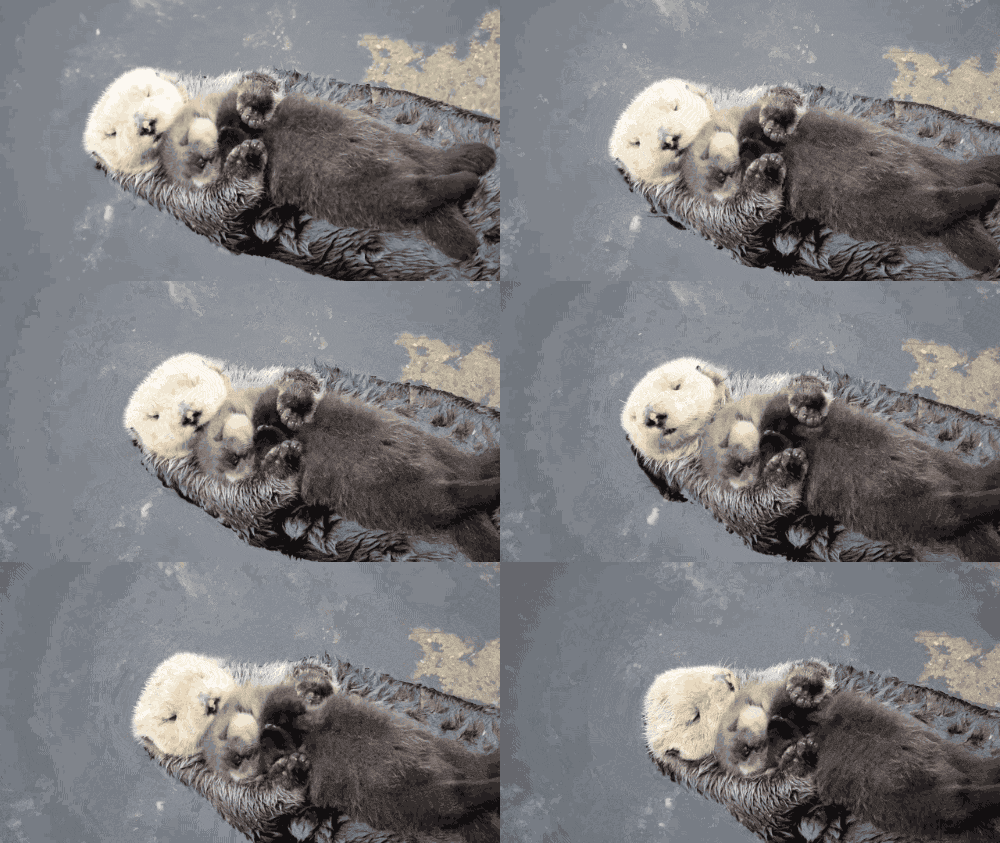
The furry little animals are often featured in gifs, floating around, snuggling each other and their babies.
There are actually a lot of different species of otters: bigger river-otters and tinier sea-otters, from different corners of the earth. The sea otter spends most, if not all of his life in the water. River otters go anywhere, both land and water.
The sea otter is an aquatic mammal (the river otter is semi-aquatic), and is part of the weasel family. The sea otter has very large feet with webbed toes, making it easier to navigate through the water with strong leg movements. Usually, aquatic mammals have a lot of fatty blubber to keep them warm, which this slim and tiny otter obviously does not have. Still, they need to isolate themselves in the cold water they float in. Luckily, the otter has the densest fur coat of all animals with two layers 155.000 hairs per squared centimeter (!!!!).
Their beautiful thick fur allows them to remain warm and protected in cold waters. The outer layer of fur protects the inner layer, and serves as an isolator to prevent the inner one from getting wet. Unfortunately, their fur was also one of the reasons they were almost hunted down to extinction in the 17th century. Nowadays, fur-trade has been reduced significantly and, while still endangered, otters have made their comeback…!
It is important to protect the otter from other man-made threats, and prevent extinction, as otters are a keystone species. A keystone species means that they are essential in sustaining the health and stability of their ecosystem. They are stealthy hunters, cleverly keeping themselves and their environment in a healthy balance. I always start to wonder how this is driven and what it would be like to live on the basis of hunt and be hunted. How does the otter perceive her environment, and think about the choices she makes?
In Otter Words: Otters look cute and are fluffy. This has caused them quite a bit to worry about. Luckily, otters are quite clever too. The world in your eyes may be a very different place from when looking at it through someone else’s. Sometimes, it might be a refreshing to think what it would be like through the eyes of an otter.





 In Otter Words